The "Butterfly Effect" is the propensity of a system to be sensitive to initial
conditions.Such systems over time become unpredictable,this idea gave rise
to the notion of a butterfly flapping it's wings in one area of the
world,causing a tornado or some such weather event to occur in another remote
area of the world.
Comparing this effect to the domino effect,is
slightly misleading.There is dependence on the initial sensitivity,but whereas a
simple linear row of dominoes would cause one event to initiate another similar
one,the butterfly effect amplifies the condition upon each iteration.
The butterfly effect has been most commonly associated with the Weather system as this is where the discovery of "non-linear"
phenomenon began when Edward Lorenz found anomalies in computer models of the weather.
But Henri Poincaré had already made inroads into this area. Mapping the results in phase
space" produced a two-lobe map called the Lorenz Attractor.
The word attractor meaning that events tended to be attracted towards the two lobes,and events
outside of the lobes are such things like snow in the desert.
The attractor acts like an egg whisk,teasing apart
parameters that may initially be close together,this is why the weather is so
hard to predict.  Super computers
run several models of the weather in parallel to discover whether they stay
close together or diverge away from each other.Models that stay similar in
nature give an indication that the weather is relatively predictable,and are
used to indicate the confidence level that Meteorologists have in a prediction.
Super computers
run several models of the weather in parallel to discover whether they stay
close together or diverge away from each other.Models that stay similar in
nature give an indication that the weather is relatively predictable,and are
used to indicate the confidence level that Meteorologists have in a prediction.
It is not just the weather though that is subject to
such phenomena.Any "Newtonian Classical" system where one system is in competition with another,such as
the "Chaotic Pendulum" which plays magnetism off against gravity will
exhibit "sensitivity to initial conditions".
 Animal
populations may also be subject to the same phenomena.Work done by Robert
May,suggests that predator-prey systems have complex
dynamics making them prone to "boom" and "bust",due to the difference
equations that model them. Such a system even with two variables
such as Rabbits and Foxes can create a system that is much more complex than would be thought to be
the case.Lack of Foxes means that the Rabbit population can increase,but
increasing numbers of Rabbits means Foxes have more food and are likely to
survive and reproduce,which in turn decreases the number of Rabbits.It is
possible for such systems to find a steady state or equilibrium,and even though
species can become extinct,there is a tendency for populations
to be robust,but they can vary dramatically under certain circumstances. Real
populations of course,have more than two variables making them ever more
complex.But as can be seen from the diagram, such systems are not as simple as
might be thought.
Animal
populations may also be subject to the same phenomena.Work done by Robert
May,suggests that predator-prey systems have complex
dynamics making them prone to "boom" and "bust",due to the difference
equations that model them. Such a system even with two variables
such as Rabbits and Foxes can create a system that is much more complex than would be thought to be
the case.Lack of Foxes means that the Rabbit population can increase,but
increasing numbers of Rabbits means Foxes have more food and are likely to
survive and reproduce,which in turn decreases the number of Rabbits.It is
possible for such systems to find a steady state or equilibrium,and even though
species can become extinct,there is a tendency for populations
to be robust,but they can vary dramatically under certain circumstances. Real
populations of course,have more than two variables making them ever more
complex.But as can be seen from the diagram, such systems are not as simple as
might be thought.
The chemical world is also not free from such intrusions of
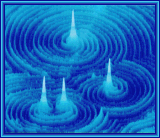 non-linearity.In
certain cases chemical feedback produces effects as that in the Belousov-Zhabotinsky
reaction, creating concentric rings, which are produced by a chemical
change, whose decision to change from one state to another cannot be
predicted.The B-Z chemical system is currently being trialled as a means to
achieve artificially intelligent states in robots.
non-linearity.In
certain cases chemical feedback produces effects as that in the Belousov-Zhabotinsky
reaction, creating concentric rings, which are produced by a chemical
change, whose decision to change from one state to another cannot be
predicted.The B-Z chemical system is currently being trialled as a means to
achieve artificially intelligent states in robots.
Phase space
portraits of liquid flow show that they too are subject to the same kind of
non-linearity that is inherent in other physical systems.It may be apparent when
turning on a tap that sporadic drips become "laminar" as the flow increases.What
might not be apparent is the nature of the change from semi-random to
continuous.It may seem rather at odds with intuition that such natural systems
have inherent behaviour that is not random,or indeed that is not capable of
being predicted.It may also seem that "not random" means "predictable".
Natural systems can present a tangled mix of determinism and randomness, or
"order" and 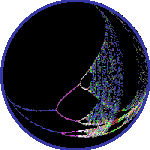 "chaos".In
such cases as water moving from drips to continuous flow, pictures called
"Bifurcation diagrams" demonstrate the nature of movement from order into
chaos.This bifurcation is based on Robert May's work,but one of the intriguing
things about bifurcations is that the same pattern occurs no matter what system
is iterated.In fact Mitchell
"chaos".In
such cases as water moving from drips to continuous flow, pictures called
"Bifurcation diagrams" demonstrate the nature of movement from order into
chaos.This bifurcation is based on Robert May's work,but one of the intriguing
things about bifurcations is that the same pattern occurs no matter what system
is iterated.In fact Mitchell
 Feigenbaum discovered that there was a "constant of doubling"
hidden in amongst all these systems.
Feigenbaum discovered that there was a "constant of doubling"
hidden in amongst all these systems.
Electronic apparatus is also not free from such
effects,and it is perhaps ironic,that we think of electronic apparatus as
as being the epitome of predictable determinism and ruthless clockwork
efficiency.Indeed the powerful computers used to predict weather,would seem
ineffectual if they were not ruthless automatons.But such effects occur only in
certain circumstances where there is "sensitivity to initial
conditions".Amplifiers for instance,produce a howl when feedback occurs
as they go into a stable state of oscillation.Logic gates
as used in computers have to select a "0" or a "1",and this relies on
choosing between two states whose boundary is indeterminate,and it is
when a computer confuses a "0" for a "1" or vice versa that mistakes occur.
далее: Практическое задание 1
